
Vintage report
The legendary Bordeaux vintages since 2000
A data-driven look at the five legendary Bordeaux vintages since 2000.
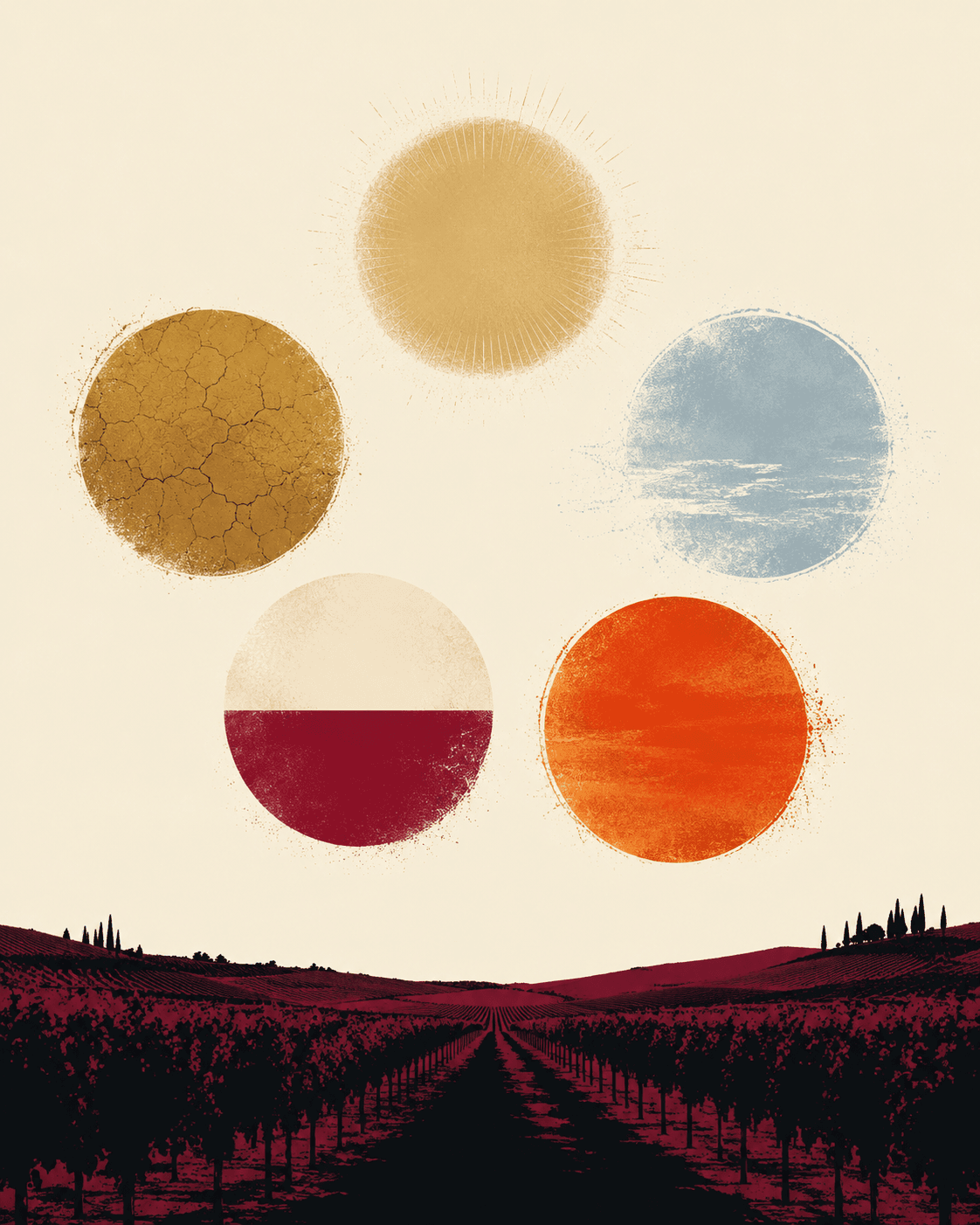
Every wine shop will tell you that 2005 and 2010 were great Bordeaux vintages. Almost none of them will tell you why. So I decided to write an article providing a proper look at the five legendary Bordeaux vintages since 2000, built on weather data, appellation-level critic scores, and market prices.
In short
- A dry September, low yields and small, concentrated berries make a great Bordeaux vintage.
- 2000 is a broad, classic vintage now entering its drinking window.
- 2005 is a drought year of tightly-built wines only now beginning to open.
- 2010 is ripe but balanced, at the start of a long life.
- 2016 and 2022 are modern benchmarks for the cellar — 2016 near-flawless, 2022 still unproven.
- These vintages trade 32–90% above ordinary years.
❦
01What makes a Bordeaux vintage great?
For three centuries, Bordeaux picked its grapes around 26 September on average. Between 1981 and 2007, the average harvest moved 9.3 days earlier, according to NASA satellite data analysed by Cook & Wolkovich in a Harvard study.
That earlier harvest has changed what Bordeaux tastes like. The old problem in Bordeaux was rot: in this damp Atlantic climate, autumn rain and fungal pressure used to force growers to pick before the grapes were truly ready. The sugar was there, but the seeds and skins were not. That is why so many classic Bordeaux of the 1970s and 1980s had a green, slightly hard edge, the taste of tannins that never fully ripened. Finished wines back then mostly sat around 11 to 12% alcohol, and in weaker years producers added sugar during fermentation just to get there.
Warmth solved the ripeness problem and created a new one. With longer, hotter summers, growers can now wait for full phenolic ripeness, the point where skins, seeds and tannins all mature, instead of racing the rain. The tannins that come off the vine today are rounder and softer, the fruit is darker and sweeter, and the green notes have largely gone. But riper grapes also carry more sugar, and more sugar means more alcohol. A Liv-ex study of 35,000 wines found Bordeaux reds averaged 12.8% alcohol in the 1990s, 13.4% in the 2000s, and 13.7% in the 2010s. At the top estates in the hottest years, 14.5% is now normal and some right-bank Merlots have touched 15%.
Why does all of this trace back to the weather? Because everything that makes a vintage legendary happens in the vineyard, months before anyone touches a barrel. The vine needs an even flowering in June, a warm and dry July and August to build sugar and tannin, and above all a dry September. Bordeaux sits next to the Atlantic, which means fungal pressure is a constant threat and rain during harvest is the great enemy: it swells the berries, dilutes the juice, and can undo an entire season in a week.
Another important factor is yield. Great vintages almost always produce less wine. A vine carrying small, concentrated berries at 35 hectolitres per hectare makes a fundamentally different wine than one at 55. The drought years below all share this: tiny berries, thick skins, low yields.
Five vintages define the era since 2000. They are not ranked in order.
| Vintage | Character | Style | Peak window | Standout bank |
|---|---|---|---|---|
| 2000 | Classical, complete | Structured, elegant | Now to 2035 | Both |
| 2005 | Drought-built, concentrated | Tight, age-worthy | 2025 to 2050 | Left Bank |
| 2010 | Precise, intellectual | Classical, long | 2028 to 2060 | Both |
| 2016 | The reference point | Near-perfect balance | 2030 to 2070 | Left Bank |
| 2022 | Richest, most extreme | Opulent, concentrated | 2028 to 2065 | Still debated |
❦
02Vintage 2000
There is a cynical reading of 2000: a good vintage inflated to legendary status by the round number on the label. The cynical reading is wrong. After a damp and nervous summer, September 2000 turned warm and bone dry exactly when it needed to, and the late-ripening Cabernet of the Left Bank got a long, unhurried finish to the season. Wine Spectator awarded 100 points to just three wines that year: Lafite Rothschild, Latour, and Léoville Las Cases.
The appellation scores show how broad the success was:
| Appellation | Robert Parker Wine Advocate | Wine Enthusiast |
|---|---|---|
| St-Julien / Pauillac / St-Estèphe | 96 | 96 |
| Margaux | 94 | 96 |
| Pessac-Léognan | 97 | 96 |
| Pomerol | 95 | 97 |
| Saint-Émilion | 96 | 97 |
Wine Enthusiast rates the four Médoc communes as one score, and Pomerol together with Saint-Émilion. This applies to every table in this article.
Parkers scores for every appellation above still carry the code T, meaning tannic, youthful, or slow to mature. The 2000s are finally in their proper drinking window, with softer tannins and tertiary notes showing. Our Léoville Las Cases 2000 is one of those three 100-point wines, just now opening up.

❦
03Vintage 2005
In 2005, France experienced its worst drought since 1976. Château Palmer recorded 57% less rainfall than usual across the growing season, and unlike the brutal heatwave of 2003, temperatures stayed moderate. The vines were never cooked, just relentlessly dried out. The result was tiny berries, very low yields, and a level of concentration Bordeaux had not seen in decades.
| Appellation | Robert Parker Wine Advocate | Wine Enthusiast |
|---|---|---|
| St-Julien / Pauillac / St-Estèphe | 95 | 100 |
| Margaux | 98 | 100 |
| Pessac-Léognan | 96 | 95 |
| Pomerol | 95 | 98 |
| Saint-Émilion | 99 | 98 |
The caveat of 2005; these wines were built so tightly that many are only now, 20 years on, beginning to open. Our Palmer 2005 comes from that 98-point Margaux heart of the vintage.

❦
04Vintage 2010
The 2009 and 2010 vintages arrived back to back, both brilliant, and the wine world has argued about them ever since. 2009 was warm and generous, producing ripe, immediately charming wines. 2010 was warm but never extreme, with a dry summer, cool nights in September, and naturally low yields. The wines combine full ripeness with the acidity and tannic spine of a classical vintage. Precision over power.
| Appellation | Robert Parker Wine Advocate | Wine Enthusiast |
|---|---|---|
| St-Julien / Pauillac / St-Estèphe | 98 | 100 |
| Margaux | 95 | 100 |
| Pessac-Léognan | 99 | 97 |
| Pomerol | 95 | 98 |
| Saint-Émilion | 94 | 98 |
Wine Enthusiast rates the 2010 Médoc 100, level with 2005 and above 2016. But notice Saint-Émilion: Parker has it at 94, the lowest cell in any table in this article, and even the kinder Wine Enthusiast number sits below its Médoc score. That gap is exactly what makes our bottle from this vintage interesting: Château Figeac, with roughly two-thirds of its vineyard planted to Cabernet on warm gravel, behaves more like a Médoc estate than a typical Saint-Émilion one. In 2010 it beat its own appellation comfortably, scoring 98 from James Suckling and 97 from the Wine Advocate. The Figeac 2010 is the outperformer of an underrated corner of a great vintage.

❦
05Vintage 2016 & 2022
There is near-consensus that 2016 is the finest Bordeaux vintage of the modern era. The season reads like a textbook: clean flowering, no real disease pressure, a dry August and September with just enough water stress to concentrate the berries without exhausting the vines. James Suckling described the wines as having the classicism of the 1980s with far more precision.
Then 2022, the weather numbers are almost absurd. July 2022 was the driest in Bordeaux since 1959, with an average of 3 millimetres of rain across the region. Temperatures passed 40°C in multiple heatwaves, there were more days above 30°C than in any vintage on record, and for the first time irrigation was authorised in Pomerol, Saint-Émilion, and Pessac-Léognan.
| Appellation | 2016 RP | 2016 WE | 2022 RP | 2022 WE |
|---|---|---|---|---|
| St-Julien / Pauillac / St-Estèphe | 97 | 98 | 95 | 95 |
| Margaux | 97 | 98 | 95 | 95 |
| Pessac-Léognan | 97 | 96 | 94 | 94 |
| Pomerol | 97 | 97 | 95 | 95 |
| Saint-Émilion | 96 | 97 | 95 | 95 |
RP = Robert Parker Wine Advocate, WE = Wine Enthusiast.
2016 has been scored consistently high whereas the 2022s score a bit lower. However, these wines are still infants, and critics like Jane Anson have flagged that acidity levels are generally low, with pH values close to the edge of what is safe for very long ageing. Whether 2022 ages like 2016 is a question only the 2040s can answer.
❦
07Does the market agree with the critics?
Critic scores are opinions. Prices are evidence. To test whether the market actually believes in these five vintages, I pulled average market prices from Wine-Searcher for seven wines across the major appellations: Lafite Rothschild and Mouton Rothschild in Pauillac, Léoville Las Cases in Saint-Julien, Palmer in Margaux, Haut-Brion in Pessac-Léognan, Figeac in Saint-Émilion, and La Fleur-Pétrus in Pomerol. Then I indexed each wine against its own price in ordinary years.
The market knows. Every one of the five legendary vintages spikes above the line, across all seven wines, and the size of the premium tells its own story. The 2005s trade 51% above ordinary years on average, the 2010s 49%, the 2016s 34%, and the 2022s 32%. The 2000s top the chart at over 90%, but a large part of that is one bottle: Mouton Rothschild 2000, with its special millennium bottle, trades at €1,995 against an ordinary-year median around €560 for the estate. Strip Mouton out and the 2000 premium is still roughly 66%, the highest of the five.
In practical terms: the 2000s are drinking now and will hold until 2035. The 2005s are just starting to open. The 2010s are at the very beginning of a long window, and the 2016s and 2022s belong in a cellar for years yet. So the real question is not which vintage is best, but what you want the bottle for. If the answer is drinking in the next five years, 2000 is the answer but you pay for it; 2005 gives you comparable legend status at a meaningful discount, if you can wait a little longer.
If you want to taste this article rather than just read it: three of the basket wines above are in our collection, in exactly the vintages discussed. For the wider context behind these prices, our report on the state of the fine wine market in 2026 covers why now is an unusually good moment to be a buyer.
The three wines from this story
❦
Sources: harvest-date research by Cook & Wolkovich (2016), published in Nature Climate Change, chart via CarbonBrief; vintage weather reports from Château Palmer, Bordeaux Index, The Drinks Business, and Jane Anson's Inside Bordeaux; appellation vintage scores from the Robert Parker Wine Advocate Vintage Chart 1970–2023 and the Wine Enthusiast 2026 Vintage Chart; estate scores from Wine Spectator, James Suckling, and The Wine Advocate; pricing data: Wine-Searcher average market prices for a seven-wine basket (Lafite Rothschild, Mouton Rothschild, Léoville Las Cases, Palmer, Haut-Brion, Figeac, La Fleur-Pétrus), consulted June 2026.
Amsterdam Vintage Wine sources vintage wines from private cellars and auction houses across Europe. Browse our collection at amsterdamvintagewine.com.